
- All
- Product Name
- Product Keyword
- Product Model
- Product Summary
- Product Description
- Multi Field Search
 English
I think a turbine ventilator is a machine with a built-in turbine. It provides air and oxygen to people who need help breathing. This turbine ventilator does not require high-pressure air from a large supply, making it versatile for use in various settings. It operates effectively in hospital rooms, clinics, or even at home. Turbine ventilators are unique for several reasons. They respond quickly, consume less power, and exhibit superior airflow trigger performance.
Here’s a quick comparison:
Feature | Turbine Ventilators | Compressor-Based Ventilators |
|---|---|---|
Maintenance and Service Issues | Less prone | More prone |
Response Time | Faster | Slower |
Power Consumption | Lower | Higher |
Air Flow Trigger Performance | Better | Not as effective |
Turbine-based ventilators do not need a central gas supply. This makes them useful in hospitals, clinics, and homes. These ventilators react fast to changes in breathing. They give better comfort and support to patients. Turbine ventilators are light and easy to carry. You can move them easily in emergencies or places with few resources. They give high flow rates and mix oxygen well. This helps lower the chance of problems like ventilator-associated pneumonia. Turbine-based ventilators do not cost much and are simple to take care of. This makes them a good choice for critical care and home use.
Inside turbine-based ventilators, many parts work together. The air chamber is the main part. It pulls in air from the room. Special valves help move the air. Electric actuators control these valves. You can change the actuators using the ventilator settings. The system controls air pressure, volume, and breath time. There is a filter at the air inlet. This filter takes out germs and viruses. Oxygen can be added if needed. The ventilator mixes oxygen with filtered air. Then, it sends the mix to the patient. These parts help make turbine-based ventilators safe and reliable.
Turbine-based ventilators use simple science to help breathing. They make pressure changes to move air in and out. The turbine spins fast and pulls in room air. Oxygen is mixed in if needed. The ventilator pushes the air-oxygen mix to the patient. The table below shows how these ventilators work:
Principle/Mechanism | Description |
|---|---|
Pressure Gradients | The ventilator uses pressure differences to move air into the lungs. |
Flow Dynamics | The design of the turbine and air paths controls how air moves. |
Gas Flow Generation | The turbine acts like a blower, creating strong airflow for each breath. |
Air Mixing | The ventilator mixes filtered room air with oxygen before sending it to the patient. |
Mechanisms | Turbine based technologies use turbines instead of pistons or bellows to generate airflow. |
Turbine-based ventilators do not need high-pressure air outlets. They do not need external compressors. You can use them anywhere. There is no need for a central gas supply. Some new models make oxygen from the air. They use special technology for this. You do not need big oxygen tanks. This makes turbine-based ventilators easy to use in many places.
Turbine-based ventilators pull in room air with a blower. The blower makes negative pressure. This draws air through a filter. The filter removes germs and dust. Oxygen can be added if needed. The ventilator mixes oxygen with filtered air. The turbine compresses the air-oxygen mix. It sends the mix to the patient at the right pressure and flow. Here is a simple table with the steps:
Process | Description |
|---|---|
Air Extraction | The ventilator pulls in room air using a blower. |
Air Filtering | The air passes through a filter to remove bacteria and viruses. |
Oxygen Addition | The ventilator mixes in oxygen before compressing the air. |
Gas Compression | The turbine compresses the air-oxygen mix and sends it to the patient. |
Turbine ventilators can give high peak flow rates. This means they give strong breaths when needed. Older models had trouble with high pressures and breath sizes. New turbine ventilators work as well as traditional ones. They are good for non-invasive ventilation modes. Studies show turbine ventilators handle leaks better. They keep patients more comfortable. They help stop problems like auto-triggering. They make it easier for patients to breathe with the machine.
Tip: Turbine-based ventilators are great for emergencies and moving patients. They do not need a central gas supply or heavy equipment.
Pneumatic ventilators work in a different way than turbine-based ventilators. Pneumatic ventilators need a steady flow of compressed air or oxygen from a central system. They use quick valves to mix and send this air to the patient. These machines depend on the hospital’s gas supply. If the gas stops, the ventilator will not work. Turbine-based ventilators use a brushless turbine to make pressurized air. They do not need a central gas supply. This makes them more flexible, especially where compressed gas is not available.
Piston ventilators have a motor that moves a piston back and forth. This pushes air into the patient’s lungs. Both piston and turbine-based ventilators use room air and can save oxygen when it is low. Piston ventilators have fewer moving parts, so they need less maintenance. Turbine-based ventilators are more complex and may need more care over time. Here is a table that shows some differences:
Feature | Piston Ventilators | Turbine-Based Ventilators |
|---|---|---|
Performance | Economical in oxygen use, good for low oxygen | Economical in oxygen use, good for low oxygen |
Maintenance | Lower, fewer moving parts | May need more, more complex |
There are some clear differences in how these ventilators work and where they fit best. Compressor based ventilators and compressed gas-based ventilators need a central gas supply. Turbine-based ventilators do not need this. This makes turbine-based ventilators easier to move and use in many places. Turbine-based ventilators can quickly adjust to a patient’s needs. They give smoother airflow and better comfort. Compressor based ventilators and compressed gas-based ventilators are not as flexible.
Some important points are:
Turbine-based ventilators use room air, so they work without a gas supply.
They respond quickly to changes in breathing, which helps patients feel better.
Their small size makes them easy to move and set up.
Compressor based ventilators and compressed gas-based ventilators need a steady gas supply, so they cannot be used everywhere.
Turbine-based ventilators can work at a constant speed and match ICU ventilators. But they may only use room air or pure oxygen, which can limit their use sometimes. Piston ventilators use one gas circuit and a computer-controlled motor, which changes how they deliver air.
Note: I always check what my patients need and what equipment I have before I pick a ventilator. Turbine-based ventilators give me more choices when I do not have compressed gas.
I want equipment that works anywhere. Turbine-based ventilators do not need a central gas supply. I can use them where there is little or no medical oxygen. These ventilators pull in air from the room. They mix it with oxygen if needed. I do not have to depend on a hospital’s oxygen supply or tanks. This makes turbine-based ventilators a good choice for clinics, ambulances, and homes. I can help patients breathe without searching for high-pressure oxygen. This flexibility saves time and lowers stress in emergencies.
When I move between rooms or travel with equipment, I need something light. Turbine ventilators are easy to carry and use little power. I can run them for hours on battery power. Some models work with solar or wind energy. This helps in places where electricity is not steady. Here is a table that shows how turbine-based ventilators compare to others:
Feature | Turbine Ventilator | Other Ventilator Types |
|---|---|---|
Weight | 3.7 kg | Generally heavier |
Battery Life | 5.6 hours at 10 BPM | Often lower battery life |
Power Consumption | 16 W | Typically higher consumption |
Noise Level | 26.1 dB | Usually louder |
Portability | Highly portable | Less portable |
Alternative Power Sources | Solar, wind energy capable | Limited to grid power |
I can carry a turbine ventilator with one hand. I do not need to find a power outlet right away. This makes it great for field hospitals and moving patients. These ventilators are also quiet, which helps patients rest.
I want my patients to feel safe and comfortable. Turbine-based ventilators give high flow rates and adjust fast to each breath. This helps patients who need non-invasive ventilation. I see fewer problems like air leaks or poor matching with the patient’s breathing. Many studies show patients do better with these ventilators. They get less ventilator-associated pneumonia, barotrauma, and tracheal injury. The chart below shows how non-invasive ventilation with turbine-based ventilators compares to invasive mechanical ventilation:
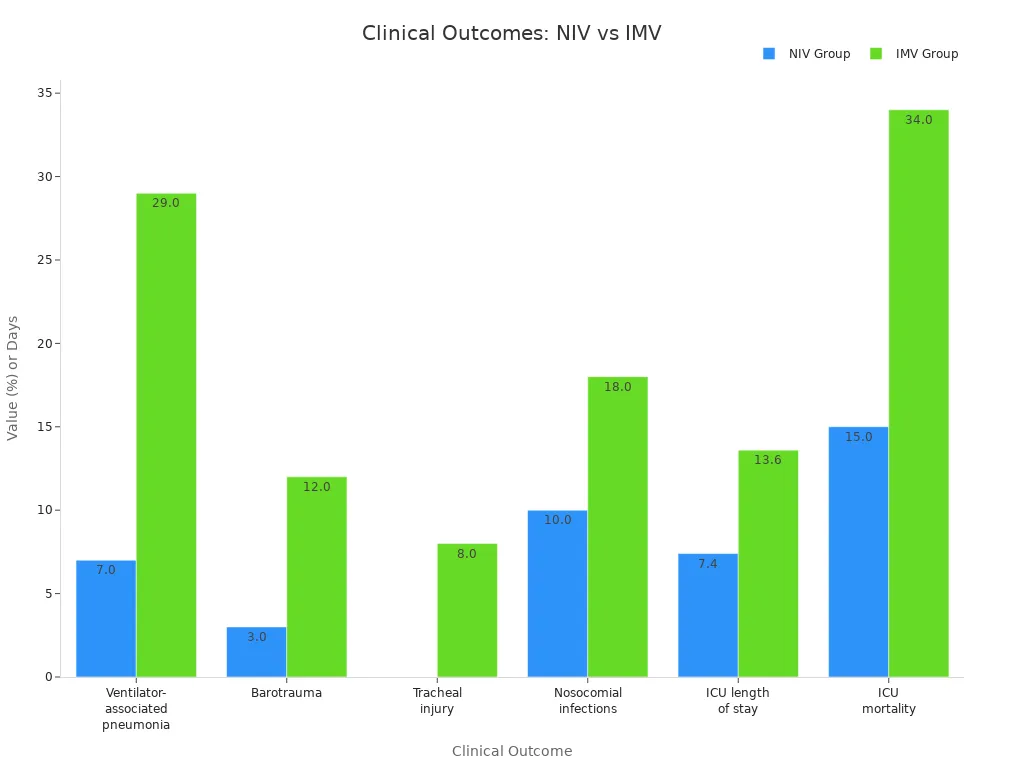
Here is a table with more details:
Outcome | NIV Group (%) | IMV Group (%) | Statistical Significance |
|---|---|---|---|
Ventilator-associated pneumonia | 7.0 | 29.0 | χ² = 17.9, p < 0.0001 |
Barotrauma | 3.0 | 12.0 | χ² = 7.24, p = 0.0072 |
Tracheal injury | 0.0 | 8.0 | χ² = 10.0, p = 0.0016 |
Nosocomial infections | 10.0 | 18.0 | Not significant (p = 0.103) |
ICU length of stay (days) | 7.4 ± 3.1 | 13.6 ± 5.4 | t = 13.7, p < 0.0001 |
ICU mortality | 15.0 | 34.0 | χ² = 11.9, p = 0.0006 |
I see that turbine-based ventilators help patients spend less time in the ICU. They also lower the risk of problems. Some models, like the Philips Trilogy Evo, are very comfortable. They match the patient’s breathing well. Other ventilators, like the Dräger Savina 300 and Servo Air, are also comfortable. I always pick a ventilator that helps my patients breathe easily and safely.
I trust turbine-based ventilators in emergencies. I can use them even when there is no electricity. This makes them great for disaster areas and places with few resources. I have seen turbine ventilators give controlled breaths using pressurized gas. This is important for patients who need critical care. Some models cost less than 100 USD and are easy to make and reuse. This matters when money is tight.
During CPR, I use a turbine ventilator to keep the breathing rate steady. Studies show these ventilators help teams follow CPR rules better. They keep the breaths at 8 per minute, which is best for patients. I see fewer stops in chest compressions when I use a turbine ventilator instead of a self-inflating bag.
I also use turbine-based ventilators for high-level critical care. The ACUTE-19 ventilator, for example, gives good oxygen and ventilation. This helps patients with breathing problems get better. I know that turbine-based ventilators are an important part of my tools for mechanical ventilation.
Tip: I always keep a turbine ventilator ready for emergencies. Its flexibility and power efficiency make it a must-have for any critical care team.
I use turbine-based ventilators in hospitals and ICUs. These machines help people who cannot breathe by themselves. I use them for both non-invasive and invasive ventilation. When I move a patient, I use a turbine-driven transport ventilator. This keeps the patient safe during the move. In emergencies, I need a ventilator that starts fast and is easy to use. Turbine-based ventilators are good for this. Some patients cannot cough, so I use these ventilators to help clear their lungs. The table below shows how I use these machines in the hospital:
Application Type | Description |
|---|---|
Intensive Care Ventilation | Used for patients who cannot breathe alone, with both non-invasive and invasive methods. |
Transport Ventilation | Used for stable patients when moving them from one place to another. |
Emergency Ventilation | Gives quick help to patients who cannot breathe, with simple controls. |
Cough Therapy | Helps patients who cannot cough by moving air to clear their lungs. |
I have read studies that compare turbine-based ventilators to compressed gas ventilators in covid-19 ICUs. These studies show that turbine-based ventilators work well and keep patients safe.
I often send patients home with turbine-based ventilators. These machines are light and can run for hours on battery power. I can carry one with just one hand. The Servo-air ventilator gives ICU-level care even when moving patients. Its turbine technology gives strong but gentle airflow. I use it for both kids and adults. The ventilator checks oxygen use and shows real-time data. I can put it on a trolley or a fixed base. It works in hot, cold, or dusty places. I can send patient data to the hospital for remote checks. Here are some features I like:
Small and strong design for easy transport.
Works for both adults and children.
Oxygen management tool to save oxygen.
Settings can be changed for different patient needs.
When I move patients, I trust turbine-based ventilators to give the right amount of oxygen. I check the expired tidal volume to make sure the settings are right. During the COVID-19 pandemic, I used these ventilators when ICU machines were not available. They gave good care in hard times.
I work in places where there are not many resources. Turbine-based ventilators help me care for patients without a central gas supply. These machines cost less and are easy to take care of. I do not need special tools to keep them working. I can use them in clinics, field hospitals, or rural areas. Telemedicine lets me send patient data to doctors far away. This helps me get advice and give better care. Turbine-based ventilators help patients breathe, even when I have few supplies or little oxygen.
Tip: I always pick turbine-based ventilators when I need a flexible, reliable, and low-cost way to help patients.
I think turbine ventilators are a good choice for many places. They help me control pressure better and give strong airflow. They also work well with low-pressure oxygen. I use them for both invasive and non-invasive support. I even use them for covid-19 treatment. Here is a table that shows their main benefits:
Benefit | Description |
|---|---|
Improved Pressure Control | Makes it easier for patients to breathe, even with stiff lungs. |
High Flow Rates | Gives strong airflow for non-invasive care. |
Low Oxygen Requirement | Works well when there is not much oxygen. |
Portability | Easy to move and set up anywhere. |
I use these ventilators when I need to be flexible and not depend on central gas.
I suggest them for regular and emergency care, especially when oxygen is hard to find.
Turbine-based ventilators do not need a central gas supply. They take air from the room and mix it with oxygen. This makes them easy to move and use in many places.
Yes, you can use a turbine-based ventilator at home. These machines are light and work on batteries. They are safe for people who need help breathing outside the hospital.
Always follow the user manual for cleaning. Change the filters often and wipe the outside with a soft cloth. Check for dust and make sure all parts work well before using it.
Yes, turbine-based ventilators are safe for both adults and children. You can change the settings for each person. These ventilators give gentle airflow and help keep kids comfortable.
Keep the ventilator’s battery charged. If the power goes out, the battery will keep it running. Some models let you use solar or wind power as backup.


